


Co-Founder and CEO of Siete, where he leads the growth strategy to help B2B companies in LATAM build predictable lead generation engines.
We deal with this every day working with B2B sales teams at Siete, and here's what actually works.
In the world of B2B sales and lead generation, few topics create as much confusion as the difference between an ICP and a buyer persona.
Many companies use both terms interchangeably. Others build entire marketing and outbound strategies without fully understanding how they differ. The result is usually the same: low-converting campaigns, poorly qualified leads, and sales teams spending time on prospects that were never likely to buy.
In 2026, where outbound competition is more aggressive and customer acquisition costs continue to rise, defining the right audience is no longer optional. It’s one of the most important factors in improving lead quality, optimizing pipeline performance, and increasing sales efficiency.
In this guide, we’ll break down the difference between an Ideal Customer Profile (ICP) and a buyer persona, explain when to use each one, and explore which matters more in modern B2B sales strategies.
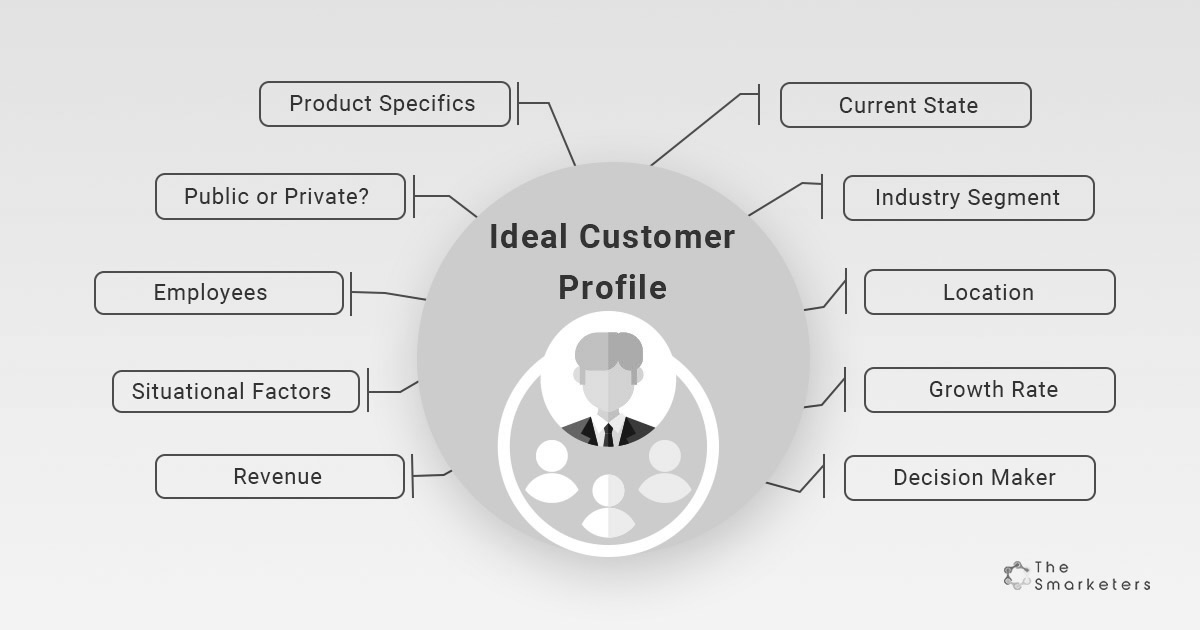
An Ideal Customer Profile (ICP) is a description of the type of company that is most likely to become a profitable and successful customer for your business.
Unlike a buyer persona, an ICP focuses on companies rather than individuals. It defines which organizations gain the most value from your solution and represent the best long-term growth opportunities.
A strong ICP typically includes variables such as:
In B2B sales, the ICP acts as a strategic filter that helps sales and marketing teams focus on companies with the highest probability of converting, retaining, and expanding.
A buyer persona represents the specific individual inside the company that you need to influence during the buying process.
While the ICP answers:
“What type of company should we target?”
The buyer persona answers:
“Who inside that company should we talk to?”
A buyer persona usually includes:
For example, your ICP could be:
“B2B SaaS companies in LATAM with more than 50 employees.”
Your buyer persona could be:
“Head of Sales looking to increase pipeline without hiring additional SDRs.”
The main difference is simple: the ICP defines the right company, while the buyer persona defines the right person within that company.
Many lead generation strategies fail because they focus heavily on buyer personas without building a strong ICP first. That often leads to campaigns targeting interesting people inside companies that were never a good fit to begin with.
In other words:
Both are important, but they serve different purposes within the B2B sales process.
In 2026, one of the biggest challenges for sales teams is not the lack of leads — it’s the lack of qualified leads.
A company can generate thousands of contacts, but if those businesses lack buying intent, budget, urgency, or alignment with the solution, the sales pipeline becomes inefficient.
This is where the ICP has a direct impact.
Companies with a well-defined ICP typically experience:
A poor ICP, on the other hand, creates operational waste. Sales teams spend time prospecting accounts that were unlikely to close from the start.
The best place to start is by identifying patterns among your most successful customers.
Key questions include:
The goal is to identify repeatable characteristics that define your ideal customer.
A strong ICP should also include buying signals that indicate a higher probability of conversion.
Examples include:
These signals help prioritize prospects that are more likely to buy in the near future.
One of the most common mistakes companies make is creating overly generic buyer personas.
It’s not enough to say:
“Marketing Director, 35 years old.”
What really matters is understanding:
The more specific the context, the more effective your outbound messaging becomes.
A message for a CEO should not look the same as a message for a Sales Manager or VP of Marketing.
Every buyer persona has different priorities.
That’s why effective outbound strategies adapt:
The better the alignment between message and persona, the higher the response rates.
Modern outbound strategies work best when ICPs and buyer personas are aligned together.
The ICP helps build prospect lists with high purchasing potential.
The buyer persona helps personalize outreach to increase engagement and booked meetings.
Without an ICP:
you target the wrong companies.
Without buyer personas:
you deliver the wrong message.
Both are necessary to build a scalable and efficient outbound system.
Many companies try to expand their ICP too broadly in an attempt to generate more opportunities.
The problem is that an overly broad ICP reduces targeting precision and lowers pipeline quality.
Another common mistake is building profiles based on internal opinions instead of actual customer data.
An effective ICP should be based on:
Data-driven targeting consistently outperforms assumption-based prospecting.
Markets evolve constantly.
Your ICP and buyer personas should evolve alongside your:
Companies that fail to update these profiles often experience declining outbound performance over time.
When sales teams work with a clear ICP:
This creates a more efficient and scalable sales operation overall.
The concept of ICPs is evolving rapidly through:
Companies are no longer segmenting prospects only by industry or company size. They are increasingly prioritizing:
The future of outbound sales will be far more precise and significantly less dependent on mass outreach.
At Siete, we help B2B companies build outbound strategies focused on quality rather than volume.
Our process combines:
The goal is not simply to generate more leads, but to generate meetings with companies that are genuinely likely to become customers.
Because in modern B2B sales, prospecting more is no longer enough. Prospecting smarter is what truly drives growth.
The debate between ICPs and buyer personas is not about choosing one over the other.
Both are essential, but they serve different purposes.
The ICP defines which companies are worth targeting.
The buyer persona defines how to communicate with the right people inside those companies.
Companies that understand this distinction build stronger pipelines, improve conversion rates, and reduce commercial inefficiency.
In an environment where lead quality matters more than ever, defining the right ICP may become the single most important competitive advantage in your B2B lead generation strategy.
Our experience running these processes at Siete: 8 to 25+ qualified meetings a month is the typical range once the process is dialed in, with a median of 12 across our B2B clients.
SIE7E. Copyright © 2026. All rights reserved.